


Jefferson County Court Launches Hope Cards to Help Survivors Carry Protection With Them
Wallet-sized cards provide a discreet, convenient way for people with full orders of protection to share critical information with law enforcement.
By The Jefferson Review
Jefferson County Associate Circuit Judge Charlie Argana helped launch the Hope Card program through Division 15 of the 23rd Judicial Circuit.
A new program in Jefferson County is giving survivors of domestic abuse and stalking a simpler way to keep critical court information close at hand.
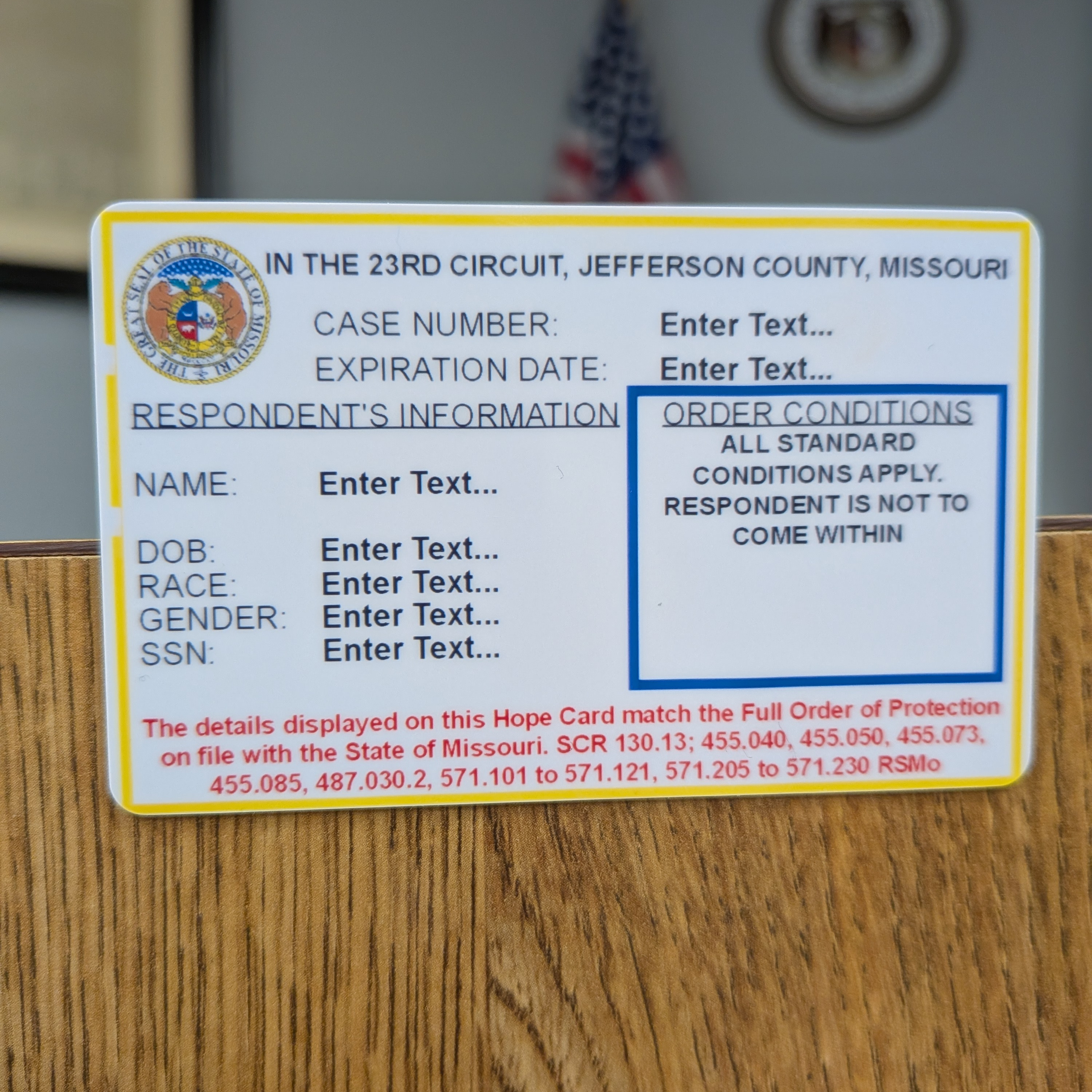
Division 15 of the 23rd Judicial Circuit has begun issuing Hope Cards to petitioners who are granted a full order of protection. The laminated, wallet-sized cards summarize the information law enforcement may need to confirm and enforce the order, eliminating the need for a survivor to carry a traditional multi-page court document everywhere they go.
Associate Circuit Judge Charlie Argana said the idea grew from conversations with victim advocates at Compass Health, who told him survivors regularly struggled with the practical burden of carrying a roughly 10-page order. After learning that courts in Clay County and St. Louis County were implementing similar programs, Argana began working to bring the cards to Jefferson County.
“I like to compare it to insurance cards.”
Judge Charlie Argana

Drivers are not expected to carry their entire insurance contract, Argana explained, but they do carry a card containing the essential information needed during an encounter.
A Hope Card can include the case number, the names and identifying information of the petitioner and respondent, the issuing court and important restrictions contained in the order. Those restrictions may include prohibitions on communication, requirements that the respondent remain a certain distance away or a restriction on firearm possession.
If a survivor unexpectedly encounters the person named in the order at a store, on the road, or elsewhere, the card can be shown to a responding officer. Law enforcement can then use the case information to locate and verify the full order in its system.
Argana said the card is also more discreet than unfolding a lengthy court packet in a public place.
“It puts them in a position where they can have more autonomy and more freedom to complete the interaction in a safer way,” he said.
Stay connected to what’s happening in Jefferson County
The Jefferson Review delivers the local government decisions, development updates and community stories shaping our county every Thursday and Sunday.
Don’t miss what your neighbors are talking about.
The cards are issued only after a judge grants a full order of protection. They are not available when someone first files a petition or receives a temporary ex parte order. Missouri law allows courts to issue an ex parte order when a petition shows an immediate and present danger, with the order generally remaining in effect until service and a hearing occur. A Hope Card does not replace the full court order or change its terms; it provides a portable summary of an already-issued full order.
The process happens inside the courtroom. After a full order is granted, a trained clerk enters the relevant information into the card-printing software and produces the card within seconds. The petitioner can leave the hearing with both the certified full order and the Hope Card.
There is no charge to the petitioner. Argana said the printer, software and supplies were obtained through existing court technology funds after consultation with the presiding judge and other members of the court. He also worked with Circuit Clerk Mike Reuter, supervising clerks and the Jefferson County Sheriff’s Office to ensure the program could be implemented smoothly.
Clay County’s Domestic Violence Court describes Hope Cards as credit-card-sized copies containing the information law enforcement needs when an order may have been violated. Clay County began offering the cards in February 2026 and identified itself as the first Missouri court to launch the program.
The cards are intended to make enforcement more efficient, but they do not guarantee an arrest or prosecution. Officers must still verify the order and evaluate the circumstances. Under Missouri law, violating certain terms of a full order of protection can be charged as a class A misdemeanor. A subsequent violation within five years can be a class E felony.
If a Jefferson County Hope Card is lost, stolen or damaged, the petitioner may file a written request with the court for a replacement. The replacement can be picked up at the courthouse or mailed when necessary.
Argana said the program’s success will ultimately be measured by whether survivors feel more confident seeking full orders and whether violations are more consistently reported and prosecuted.
“The courts are here to assist survivors of domestic abuse and stalking. We’re here to help.”
Judge Charlie Argana
“It’s our goal to make sure the community and the survivors of domestic abuse and violence are protected,” Argana said.
Anyone facing immediate danger should call 911. Missouri’s Department of Social Services directs survivors to the National Domestic Violence Hotline at 1-800-799-7233. Jefferson County’s Victim Services Unit can be reached at 636-797-5045 or 636-797-5046.