


Festus Recall Resolutions Fail After Tense Meeting and Over an Hour of Public Comment
The Festus City Council meeting opened with recognition for City Clerk Leah Smith, but the tone quickly shifted as residents packed the room to demand that recall resolutions against Mayor Sam Richards and three council members be placed before voters.
At the start of the meeting, Mayor Sam Richards read correspondence from the Missouri City Clerks and Finance Officers Association recognizing Smith for her “dedication and outstanding service to the City of Festus, Missouri.” The acknowledgment drew attention to Smith’s work at a meeting where city process, petitions, legal review, and public trust would become the central themes of the night.
Public Comment Focuses on Recall, Trust and City Facilities
What followed was more than an hour of public comment, much of it focused on the failed public trust surrounding the proposed data center project, the certified recall petitions, and the city’s handling of public input. Residents repeatedly urged the council to send the recall questions to the next available ballot, with some calling for a special election as soon as possible.
“The recall petition needs to be sent to special election as soon as possible,” Erica Carter told the council, arguing there was “zero confidence” in the board’s leadership.
Lori Merriman said the issue was no longer simply about the data center, but about whether city government would follow the process required after residents gathered thousands of signatures.
“The council should respect that process, comply with its statutory duties, and allow the citizens of Festus to decide these questions at the ballot box,” Merriman said.
Several speakers accused city officials of failing to be transparent about the data center project and the meetings that preceded it. Others focused on the recall process itself, insisting that the council had a duty to allow voters to decide. Sherman Doyle told the council, “It is your sworn duty to put this recall to vote to the residents of Festus so that we may begin to right the wrongs.”
Not every public comment focused on recall. Dana DeRousse raised concerns about long-delayed work on batting cages, saying a donated cage worth about $4,000 had still not been completed years later. “Can we please get it done?” DeRousse asked. Another speaker asked the city to invest more attention into park bathrooms, water fountains, and general maintenance, saying the city should keep facilities clean and functional if it is going to promote its parks as community assets.
City Attorney’s Opinion Made Public
The central legal moment of the meeting came when the council voted to make public the legal opinion provided by Attorney Brian Malone of Lashly & Baer, P.C. Malone told the council that his role was limited and that the final decision belonged to the elected body.
“The decision about whether or not to put these on ballot is for the council, not me as the city attorney,” Malone said. “My role is limited to giving legal advice.”
Malone described the recall process for third-class cities as a two-step process. First, he said, the county clerk reviews the sufficiency of signatures and technical requirements. If deemed sufficient, the petitions are submitted to the council. From there, the council must determine whether the petitions themselves are legally sufficient.
“My legal analysis was limited to whether or not the petitions state legal grounds, legally sufficient grounds for recall, not whether the county clerk’s determination was proper or inaccurate,” Malone said. He added that he was deferring to the county clerk on questions related to the sufficiency and number of required signatures.
Malone said the legally permissible reasons for recall are “misconduct in office, incompetency, and failure to perform duties prescribed by law.” He then said he determined the four petitions were not legally sufficient because, in his opinion, they did not state facts that constituted those grounds under the law.
He also clarified that council members facing recall were not prohibited from voting on resolutions involving their own recall. “The law does not prohibit you from participating in those votes as to your office,” Malone said.
Malone further explained that Mayor Richards could break tie votes on recall resolutions involving council members, but not on the resolution involving his own office. He said the mayor would not be permitted to break a tie “as to the resolution for the mayor,” but he did retain the ability to break ties “for other purposes.”
Before the votes, Councilman Rick Belleville spoke in favor of sending the questions to voters. He said recall has long been part of American politics and is meant to keep elected officials accountable between elections. Belleville said the certified petition count showed that residents had already taken the process seriously.
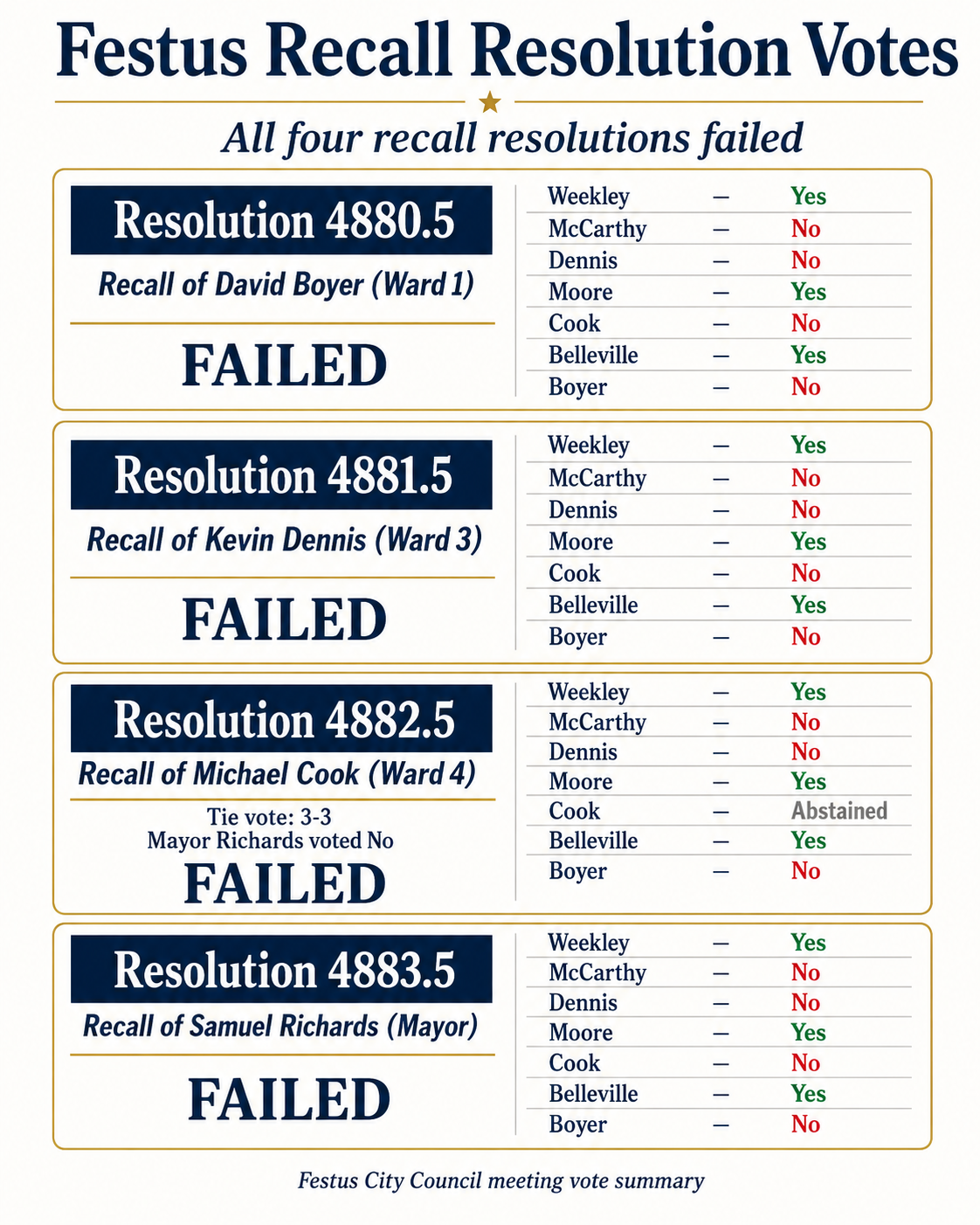
“The vote here today on each one of these resolutions should be seven to zero. Yes, for each resolution,” Belleville said.
The resolutions then came to a vote.
Tension Continues After Failed Resolutions
As the votes continued, frustration in the room grew louder. Some residents shouted accusations from the audience, and after the resolutions failed, several continued to say the fight was not over and that additional recall efforts could follow.
The council then moved into old business. Mayor Richards appointed Lori Eisenbeis as treasurer. He also appointed Councilman Allen McCarthy as the council representative to the Planning and Zoning Commission. Those appointments brought additional unrest from the crowd, especially after the recall votes had already heightened tensions in the room.
During council reports, McCarthy attempted to explain his votes, but his comments were interrupted several times by people shouting from the audience. “My vote was based around what I thought…” McCarthy began, before being interrupted. He later continued, “Our counsel had his opinion and I followed that opinion. I’m sorry if that made you guys mad.” As the exchange began to turn into an argument, Mayor Sam Richards interrupted and instructed McCarthy not to argue with the crowd. The council then moved on to other comments, including discussion about splash pad lighting and promises to work on the long-delayed donated batting cages.
By the time the meeting adjourned, the divide between many residents in attendance and several members of city leadership appeared no closer to being resolved. The recall resolutions did not move forward, but the frustration that brought residents to City Hall remained very much alive.
The Jefferson Review brings you local government coverage, community stories, events, and the issues shaping Jefferson County — straight to your inbox.
Subscribe to The Jefferson Review