

Festus Moves Water Engineering Forward After Debate Over Timing, Data Center Uncertainty
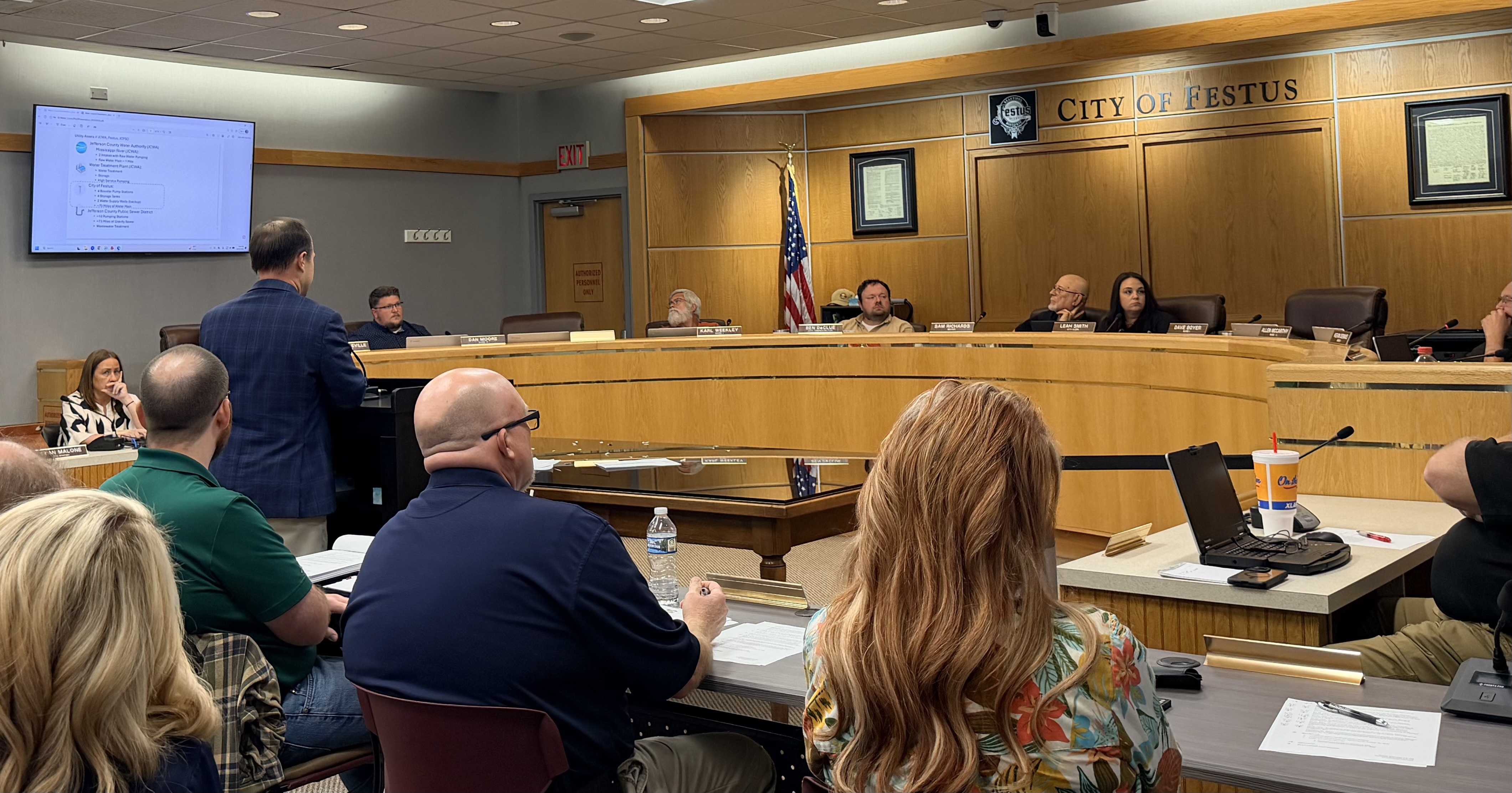
A proposed $140,000 engineering study of Festus’ water system became one of the central discussions at Monday’s City Council meeting, with council members debating whether the city should move forward now or wait for additional information surrounding the proposed hyperscale data center.
After an extensive presentation and council discussion, Councilman Rick Belleville moved to table the matter for 60 days, arguing that too many questions remain about the data center project and the timing of reimbursement to the city. The motion failed for lack of a second, and council members then voted 5-1 to approve the engineering work, with Belleville casting the lone opposing vote.
Engineering Presentation Lays Out Festus Water Needs
During the presentation, Burns & McDonnell walked council members through how water reaches Festus and where responsibility for the system changes hands.
Water is drawn near the Mississippi River and treated by the Jefferson County Water Authority before entering the City of Festus distribution system. Festus owns and operates its distribution piping, storage tanks and two backup wells, while the Jefferson County Public Sewer District handles the wastewater collection and treatment system.
The engineering discussion focused especially on the southwest portion of Festus, where the proposed data center would be located. Burns & McDonnell said the area near the Gamble booster pump station already presents challenges with water pressure and flow.
Preliminary concepts include additional transmission lines, a booster pump station and elevated water storage that could improve fire protection and water pressure in that part of the city.
The engineer emphasized that the work before the council was not final construction approval. Instead, the next phase would take the city’s existing modeling and move it toward a specific design by studying water demand, possible pipe alignments and infrastructure sizing before the city proceeds into surveying, geotechnical work, final engineering, permitting or construction.
According to the presentation, CRG currently proposes using a dry, closed-loop cooling system for the data center. Burns & McDonnell said normal daily water consumption is currently estimated at roughly 30,000 to 50,000 gallons per day for uses such as restrooms, kitchens and landscaping.
Separate fire-flow capacity of approximately 300,000 gallons would need to be available during an emergency, but the engineer emphasized that figure represents a sporadic fire-protection demand rather than everyday water consumption.
Belleville Calls for 60-Day Delay
Belleville questioned whether the city should commit money to the engineering work while details of CRG’s project remain unsettled.
He acknowledged that Festus has water-system improvements it needs regardless of the development, but questioned whether the city should move forward before knowing when anticipated reimbursement from CRG would arrive.
“Would waiting sixty days cause dramatic problems if we table this and wait until we get more information on what this project is actually going to be?”
Belleville said one of his priorities since joining the council has been to slow major decisions down.
“One of the things that I ran on when I ran for office was to try to slow things down and try to get a better picture of everything before we make decisions,” Belleville said. “This, I think, is one of those things where maybe we need to hit the brakes and table this for 60 days.”
Belleville ultimately made that motion, but no council member seconded it.
Moore Says Engineering Is Needed to Get the Answers
Councilman Dan Moore took a different view, arguing that the engineering work itself is necessary to answer many of the questions council members are asking.
Moore also pointed to discussions with the city’s water department indicating that pressure and infrastructure improvements on the southwest side are needed beyond the data center proposal.
City staff told council members that the $140,000 engineering expense was already contemplated as part of approximately $500,000 budgeted for water planning and studies. Staff also said the expense falls under provisions of the infrastructure agreement allowing qualifying engineering costs to be reimbursed.
“This is just only for the engineering,” Moore said. “We’re not approving any water infrastructure improvements yet.”
Moore said council members need the engineering results to know what improvements are actually necessary, what they could cost and what would ultimately be required.
“In order for me to make more informed decisions, I have to see that study go further,” Moore said. “Engineering has to come first a lot of times.”
That distinction framed the majority’s decision: the vote does not authorize construction of a water tower, transmission main or other major infrastructure. It authorizes the engineering necessary to determine what those projects would look like.
Final Vote Moves Engineering Forward
After Belleville’s motion to table the matter died for lack of a second, the council moved to the underlying resolution.
The engineering task order passed on a 5-1 vote, with Belleville voting no.
The approval allows Burns & McDonnell to move beyond conceptual planning and begin determining more specifically what infrastructure would be necessary to improve water delivery and pressure on the southwest side of Festus.
What the Vote Means for Festus
For Festus, the vote moves the water discussion from broad concepts toward actual engineering.
The study is expected to examine how water can be moved more effectively into the southwest portion of the city, including areas already identified in the city’s water planning as having pressure concerns.
City staff told Belleville that both the transmission main and water tower concepts had already appeared in the city’s master planning before the current vote. Staff said the Gamble Cemetery area has specifically been identified as a low-pressure zone with implications for fire protection.
That means some of the engineering work could remain useful to Festus even if the data center timeline changes.
What the vote does not settle is which projects will ultimately be constructed, their final cost or precisely when construction would begin. Those decisions would come later as the engineering becomes more detailed.
Data Center Opponents Continue Objections
The water discussion followed another lengthy public-comment period in which several residents continued to oppose the contracted data center project.
Residents raised concerns about water, noise, environmental effects, property values, transparency and the city’s relationship with CRG.
One citizen told council members that residents remain concerned about “noise, electricity, water and environmental effects” and questioned whether officials’ positions on the development had changed as public opposition continued.
Another citizen specifically addressed the Burns & McDonnell task order during public comments, asking the council to postpone the $140,000 expenditure until additional project-specific information and reimbursement commitments were available.
Heq questioned differences between various water-demand numbers that have been discussed publicly and asked that supporting engineering and written reimbursement documentation be provided before council action.
The comments demonstrated that, nearly a year into the public debate surrounding the proposed development, opposition remains active and water continues to be one of the most closely watched issues.
Downtown Events and Main Street Projects Move Forward
Council members also considered several requests involving downtown Festus.
The council approved a request from Main & Mill for its Street Fest on Oct. 10 from 1 p.m. to 11 p.m., including the closure of Main Street for the event. Police described the annual event as well-run.
The council also approved Festus R-VI School District parade requests for the Oct. 2 homecoming parade and a Veterans Day parade.
Tom Vogel, the owner of Tanglefoot Dance Hall also approached the council with plans to continue improving the area around the downtown venue.
Plans include adding string lighting over main street and murals along the side of his building. The murals will include Festus Main Street artwork intended to create another gathering and photo area downtown. The request asked the city about temporarily closing the narrow adjoining street during weekend evenings once those improvements are completed.
Councilman Dennis praised the work already done at Tanglefoot and downtown while raising one concern about maintaining access for residents with disabilities.
“You’ve been a man of your word with everything you’ve done down there,” Dennis said. “You’ve been amazing. So you bring something really good here.”
Vogel said many of his customers park behind the building, making the walk between the parking area and the dance hall an important part of the visitor experience. He said he would like to see the area become well lit, safe and welcoming for people walking to and from the venue, while also creating opportunities for photo stops, promotion of Festus and coordination with nearby accommodations. His proposal is aimed at improving both pedestrian safety and the overall experience for visitors coming downtown.
Rather than rejecting the idea, the council tabled the request to allow the city and Tanglefoot to continue working on a solution.
Later in the meeting, Dennis again recognized Tanglefoot’s effect on downtown, saying the business had helped revive the area and that many people are enjoying what has been created there.
With the engineering task order approved, Festus will now move into a more detailed examination of its water infrastructure needs. The study should provide council members with additional information on potential improvements, costs and system requirements before any major construction decisions return to the council for consideration.