

De Soto Library Controversy Ends Without Full Audit, But Serious Questions Remain
The State Auditor declined to launch a full audit, but still flagged weak documentation and unconstitutional employee bonuses.
By The Jefferson Review
The controversy surrounding the De Soto Public Library did not end with a finding of fraud, theft, or bid rigging. But it also did not end with a clean bill of health for the library board.
After months of public criticism, questions from State Rep. Bill Lucas, and a Jefferson County Council resolution supporting an audit, the Missouri State Auditor’s Office concluded that a full state audit of the De Soto Public Library was not warranted. Still, the investigative summary left behind two major concerns: the board selected the highest-cost proposal for a public renovation project without formally documenting its reasoning, and the board was told to stop awarding employee bonuses in violation of the Missouri Constitution.
That second point should not be brushed aside.
While much of the public attention has centered on the renovation bid, the bonus issue is more than a side note. In plain language, this was not just a recommendation to improve paperwork. It was a warning that a practice involving public funds had crossed a constitutional line.
The renovation controversy began after the library board awarded a contract to Tom Madden and Sons Construction of St. Louis. The project included ADA-related improvements, including replacing the front entrance doors with a sliding door, updating restrooms, improving meeting and study rooms, replacing some flooring, and adding an office.
Four bids were submitted. Harms-Troesser Construction Co. of Pacific bid $127,506. Boyer Building and Design of De Soto bid $153,293. Colben Construction of Cottleville bid $208,818. Tom Madden and Sons Construction bid $209,986. The Madden bid was selected, and an optional add-on brought the total to $216,486.
That meant the library board chose a proposal nearly $90,000 higher than the lowest bid.
The board has defended that decision, arguing the selected proposal was more complete, had a clearer project timeline, and offered more detail on the scope of work, ADA compliance, scheduling, and costs. The board has also said the lower bids lacked clarity and could have created a greater risk of unexpected expenses.
Those may be legitimate factors. Public boards are not always required to take the lowest bid. But when a taxpayer-funded board chooses the most expensive option, especially by that wide of a margin, the public deserves a clear record explaining why.
According to the Auditor’s Office, that record was missing.
The investigative summary found that the board did not document its reasoning for selecting a proposal that was not the lowest cost. It also found that, at the time the contract was awarded, the library did not have specific procurement policies and procedures in place. Instead, the board relied on its bylaws.
After the Auditor’s Office contacted the library, the board approved a procurement policy. But the Auditor’s Office still found that the new policy did not require a formal, documented bid or proposal evaluation process.
That matters because documentation is not just bureaucracy. It is the public’s receipt. When appointed officials spend public dollars, especially on a controversial contract, citizens should not have to rely on after-the-fact explanations. The reasoning should already be in the record.
The investigation found enough weakness to recommend stronger procurement rules, better documentation, and a stop to unconstitutional employee bonuses. For a board handling taxpayer money, those are not minor footnotes.
The De Soto Public Library is an independent public entity, though its board members are appointed by the De Soto City Council. That structure can create confusion for residents, especially when controversy arises. The city does not directly control the library’s spending, but the public still expects accountability from any board using public funds.
In the end, the State Auditor’s Office did not take the next step of a full audit. The library board can fairly say that no fraud or bid rigging was found. But critics can also fairly say the investigation confirmed the need for greater transparency, stronger policies, and more careful handling of public money.
The central question remains simple: if the board made the right decision, why was the reasoning not formally documented before the public had to demand answers?
Editor’s note: The Jefferson Review is including the response from State Rep. Bill Lucas’s office below, followed by a link to the State Auditor’s investigative summary.
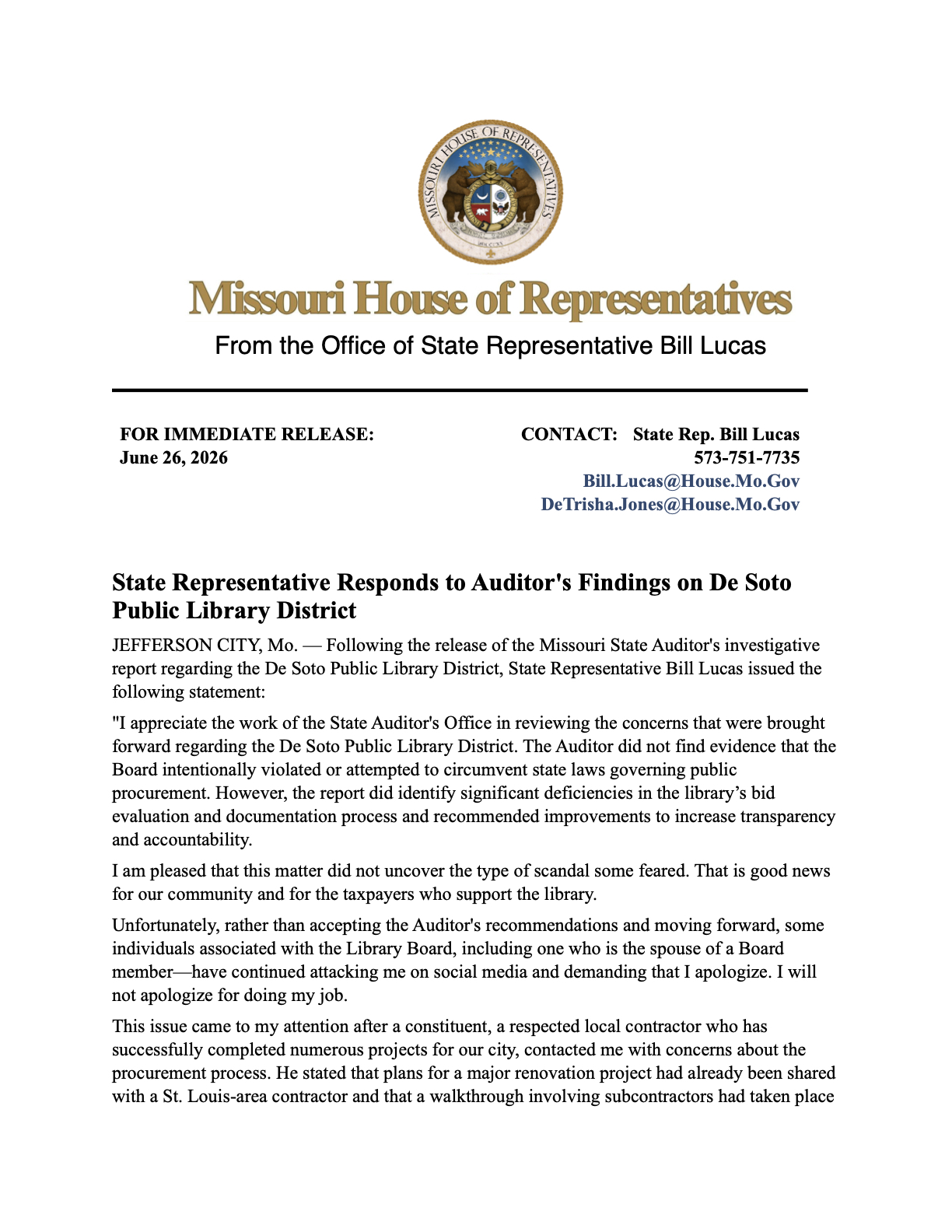
Response from State Rep. Bill Lucas’s office, page one.
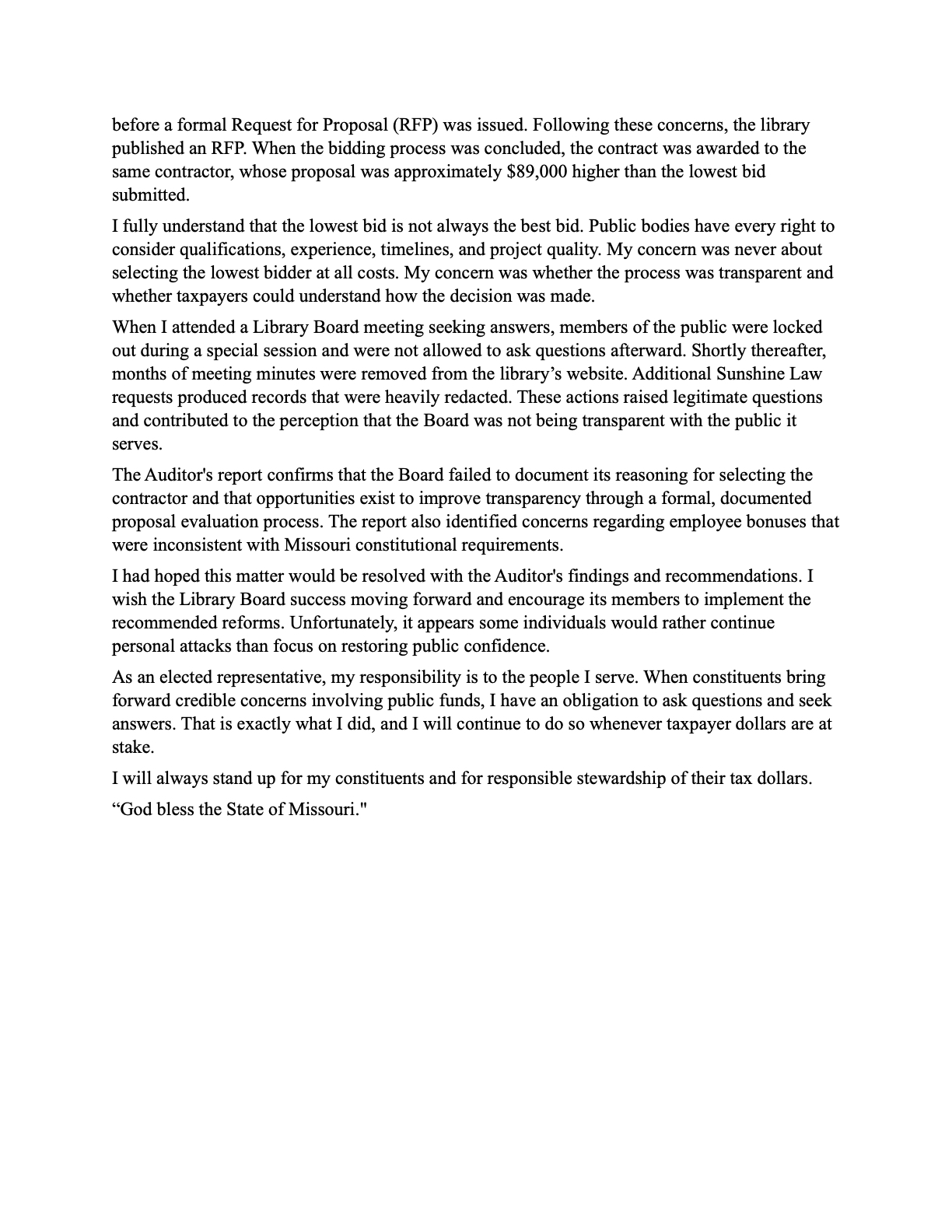
Response from State Rep. Bill Lucas’s office, page two.
Read the State Auditor’s Investigative Summary
The State Auditor’s investigative summary is available for readers who want to review the findings directly.
Stay connected to what’s happening in Jefferson County
The Jefferson Review delivers the local government decisions, development updates, and community stories shaping our county every Thursday and Sunday.
Don’t miss what your neighbors are talking about.
The issue now is whether the library board treats the Auditor’s findings as a technical correction or as a serious reminder that public trust depends on clear records, careful policies, and constitutional limits on how taxpayer money is spent.