

JEFFERSON REVIEW
SPECIAL EDITION

Arnold Residents Should Demand Transparency, Accountability, and Stronger TDD Laws
Ahead of Tuesday’s TDD meeting, David Stokes the Show-Me Institute’s Director of Municipal Policy says residents should ask for records, push for public votes, and scrutinize overlap between city officials and district boards.
As Arnold residents prepare for Tuesday night’s Transportation Development District meeting, David Stokes of the Show-Me Institute says citizens should walk in with a clear understanding of what TDDs and CIDs are supposed to be, and what they too often become.
In theory, Transportation Development Districts are created to fund transportation improvements. Community Improvement Districts are created to fund improvements such as sidewalks, beautification, security, maintenance, or other community-related needs.
On paper, that can sound reasonable.
But Stokes said the reality is often very different.
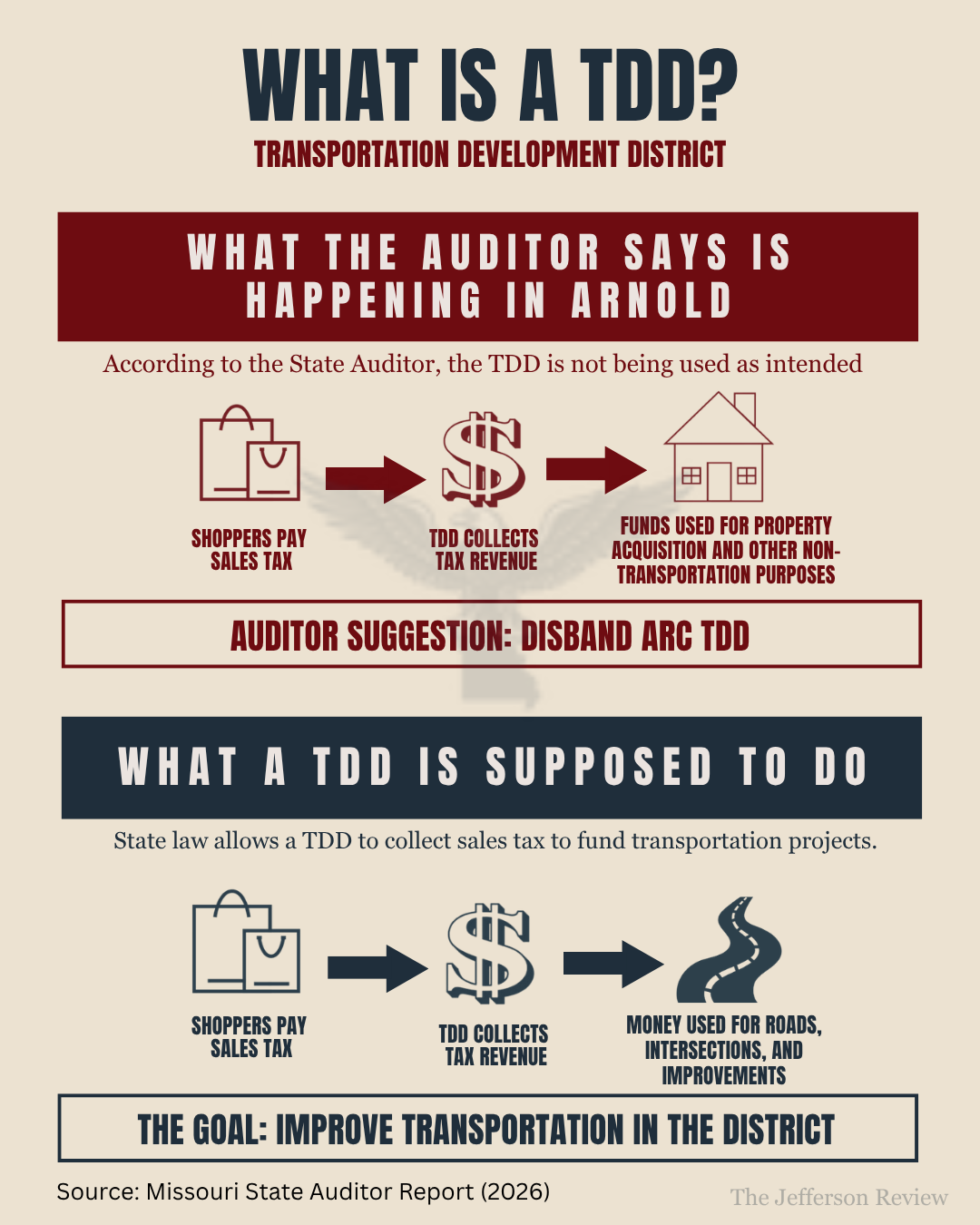
Stokes serves as Director of Municipal Policy at the Show-Me Institute, where his work focuses on local government, tax policy, open government, property rights, and government efficiency. He spoke with The Jefferson Review about TDDs and CIDs as Arnold residents continue asking questions following the recent State Auditor’s report.
Stokes said TDDs and CIDs are both special taxing districts. They are government entities created for a specific purpose, similar in structure to how school districts, fire districts, library districts, and ambulance districts exist to perform specific public functions.
But unlike those more familiar public bodies, Stokes said TDDs and CIDs often operate with far less attention from residents, media, and elected officials.
That lack of oversight matters because these districts collect public tax dollars.
Stokes said residents should not think of the money as private development money just because it is tied to a shopping center, road project, or redevelopment area.
According to Stokes, that is one of the most important things Arnold residents should understand before Tuesday night’s meeting.
These districts may involve developers, contractors, landowners, lawyers, and board members. But at the center of the issue is still public money.
And public money should come with public records, public bidding, public oversight, and public accountability.
TDDs Can Sound Good, But Residents Should Watch How They Are Used
Stokes said there are rare examples where TDDs have been used for legitimate public improvements, such as larger road projects or major infrastructure needs.
But he said those examples are the exception, not the rule.
Too often, he said, these districts are used to pay for things that developers or private landowners would have paid for themselves in the past.
That can include parking lots, sidewalks, access improvements, beautification, maintenance, or other costs tied to a private development.
The result, Stokes said, is that expenses once handled privately are shifted onto taxpayers through extra sales taxes.
That framing is important in Arnold because residents are not just asking whether a TDD is technically legal.
They are asking whether it is good public policy.
They are asking whether the district is still serving its original purpose.
They are asking whether money is being collected without a clear project, timeline, or public plan.
And they are asking whether decisions about roads, property, and taxes have been kept too far outside the normal public process.
Stokes said when a city uses a TDD instead of handling a road project through the regular city budget and public planning process, residents should ask why.
That question is simple: if the project is necessary, active, and legitimate, why not show the public the plan?
What Residents Should Demand at the Meeting
Stokes said residents should start with records.
Not rumors.
Not vague explanations.
Records.
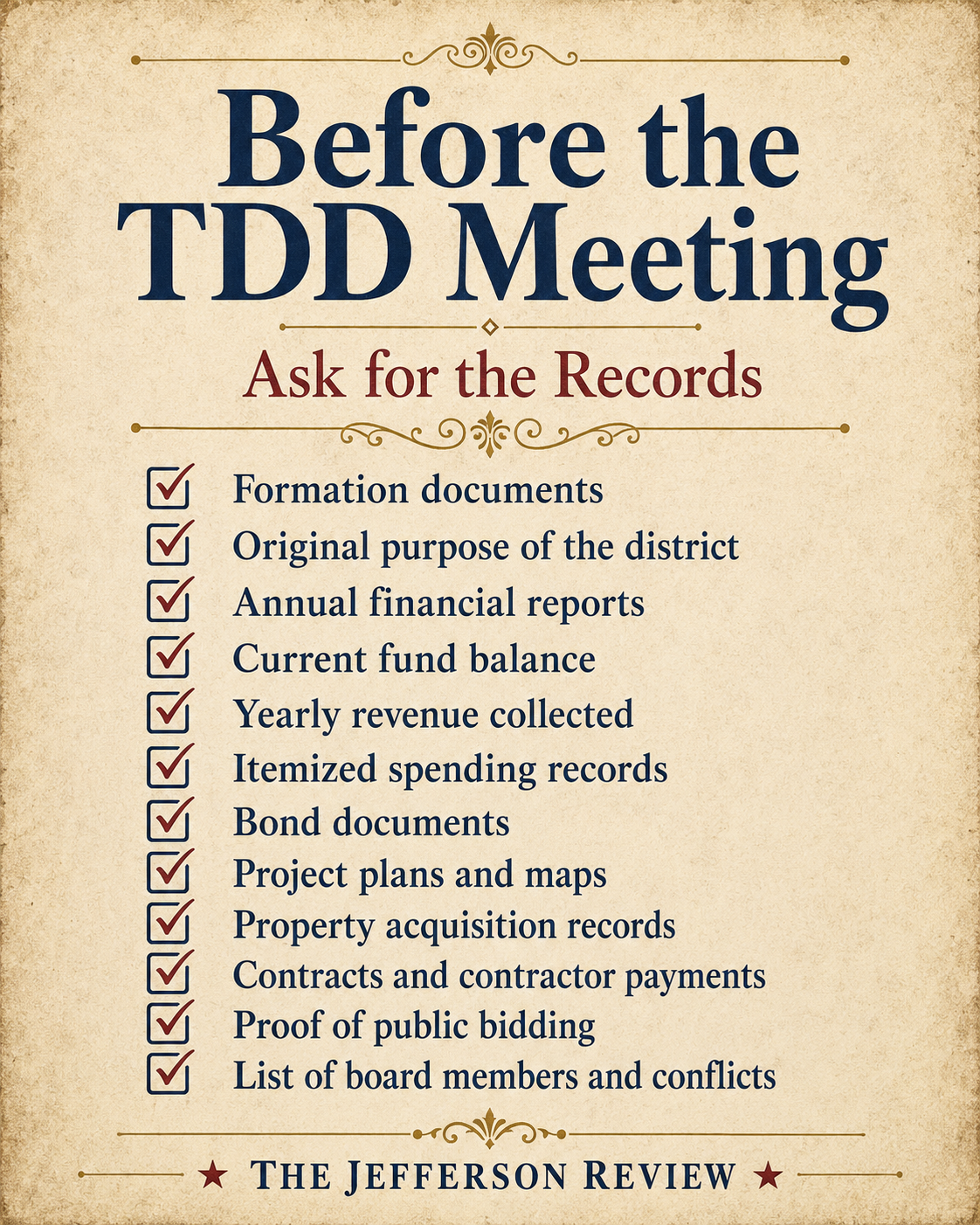
For Tuesday night’s meeting, residents should ask for the original formation documents for each district, the stated purpose of the district, annual financial reports, current fund balances, yearly revenue totals, spending records, budgets, contracts, contractor payments, board member lists, bond documents, and any project plans, maps, engineering documents, or property acquisition records tied to the district.
Residents should also ask whether work paid for by the district was publicly bid.
Stokes said residents do not need a special reason to ask for these documents.
If the district is collecting taxes, residents should be able to see how much money has been collected, how much has been spent, who approved the spending, who received the money, and what public purpose the spending served.
Stokes said if records are not provided voluntarily, residents should use Missouri’s Sunshine Law to formally request them.
Ask Whether the District Can Be Closed
Another question residents should ask is whether any existing TDD or CID can be ended early.
Stokes said that may be difficult if a district has issued bonds and tax revenue is being used to pay those bonds. But if there are no outstanding bonds and the original purpose has already been completed, residents may have a stronger case.
If there are no bonds left to pay, residents should ask whether the district is still necessary.
That matters because a district that continues collecting money without a clear current project can begin to look less like a targeted funding tool and more like a pool of money available for future spending.
Stokes was blunt about that concern.
What to Ask State Representatives to Change
Stokes said Arnold residents should also take their concerns to state lawmakers.
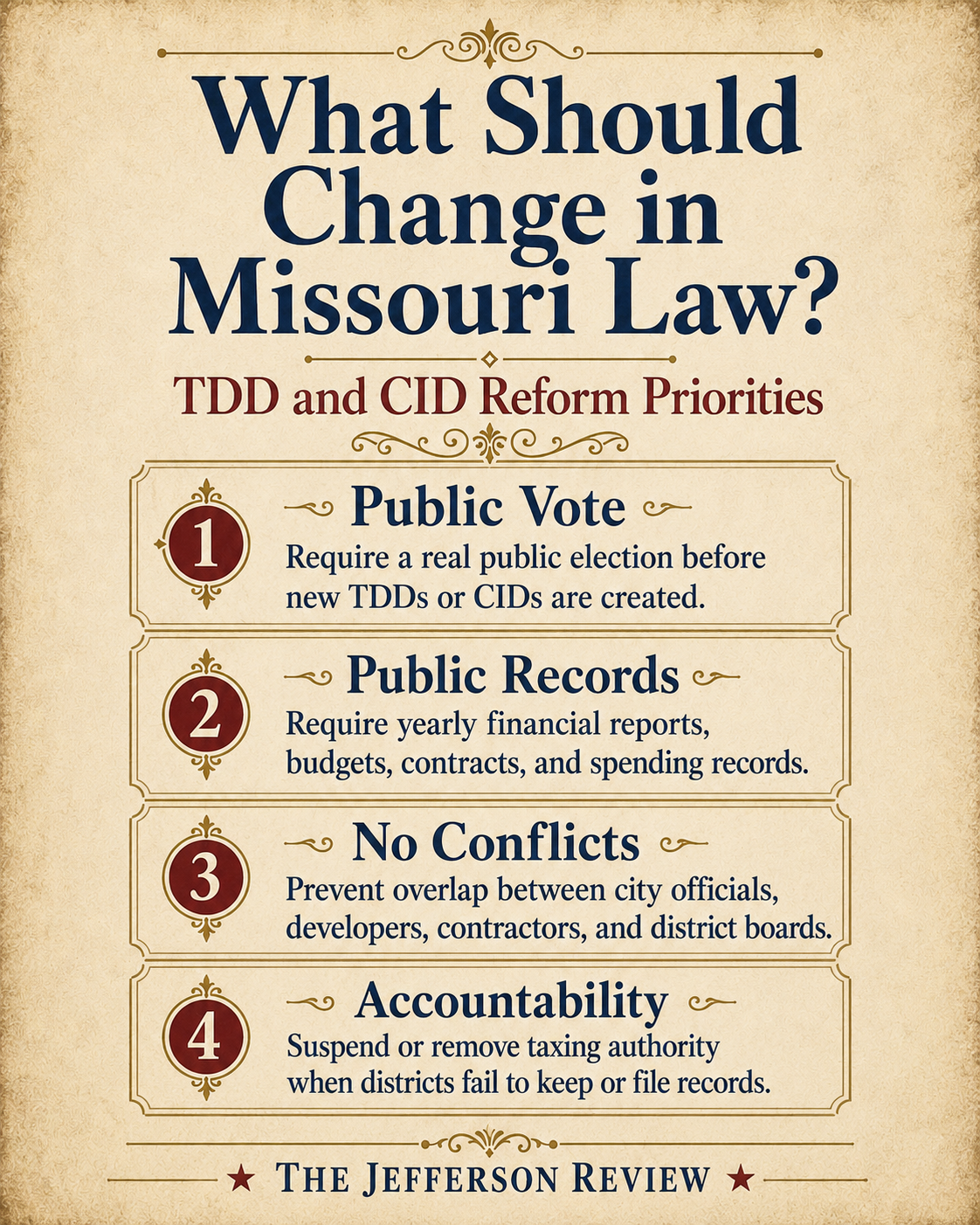
His top recommendation is that Missouri law should require a real public election before any future TDD, CID, or similar special taxing district is created.
Not just signatures from property owners.
Not a district drawn in a way that limits who can vote.
A real vote of the people affected.
He said the same principle should apply in unincorporated areas.
Stokes also said Missouri law should include stronger consequences when special taxing districts fail to file reports, keep records, or follow basic public accountability rules.
For residents speaking with state representatives, the request should be clear: require public votes, require yearly records, require meaningful penalties, and make it easier to dissolve districts once their original purpose has been completed.
No More Overlap Between City Officials and District Boards
Stokes also raised concerns about conflicts of interest and overlapping roles between city officials, developers, contractors, and special district boards.
When the same people or closely connected interests are involved in creating, overseeing, benefiting from, or spending district money, public trust becomes harder to maintain.
Stokes said some of these conflicts should not be allowed.
For Arnold residents, that means asking who sits on each district board, who appointed them, what other public or private roles they hold, and whether any board member has a relationship with contractors, developers, law firms, engineering firms, or property interests connected to the district.
The public should not have to guess who benefits from a public taxing district.
The answer should be clear in the records.
The Bottom Line for Arnold Residents
For residents walking into Tuesday night’s meeting, Stokes’ advice can be summed up simply.
Ask for the records.
Ask whether city officials and district board members have overlapping roles.
Ask whether the district can be closed.
And ask state representatives to require real public votes before future TDDs and CIDs are created.
Stokes said residents should remember that these districts may sound technical, but the principle is simple.
They collect public money.
So they should operate in public.
For Arnold, Tuesday night’s meeting is not only about one district or one project.
It is about whether public tax dollars, public planning, and public power will be handled in the open.
Editor’s note: This article is based on The Jefferson Review’s interview with David Stokes. Background information about Stokes’ role was drawn from his public biography at the Show-Me Institute.
Stay Informed. Stay Involved.
Local government decisions affect your roads, your taxes, your neighborhoods, and your voice at City Hall.
Subscribe to The Jefferson Review for local reporting, public meeting coverage, interviews, and the issues Jefferson County residents need to understand before decisions are made.
Local Leaders. Local Values. Local Accountability.