


Arnold Council Rejects Lonedell Road Rezoning, Approves New E-Bike and Scooter Regulations
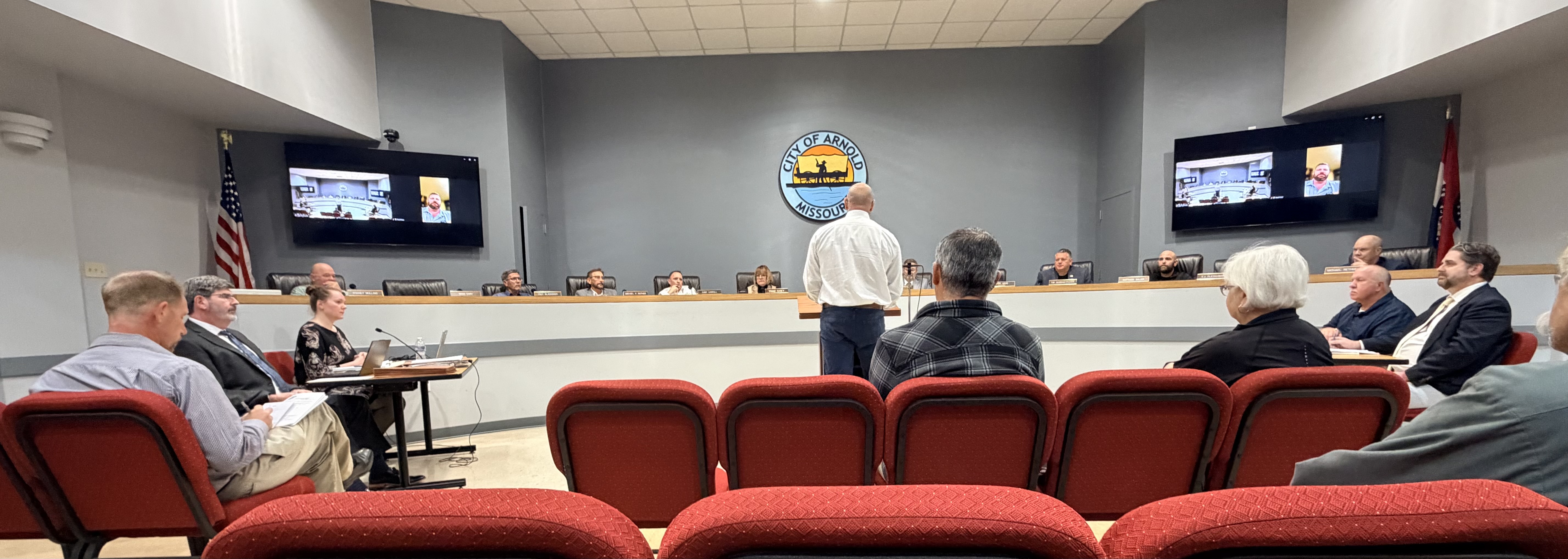
A proposed residential development along Lonedell Road was dealt a setback Thursday, November 5, when the Arnold City Council voted 5-2 against rezoning a 9.92-acre property at 2159 Lonedell Road from R-2 to R-4 residential zoning.
The decision followed months of discussion before the Planning Commission, a traffic study requested during the review process, and opposition from nearby residents concerned about roadway safety and the potential effects of additional development on their neighborhood.
The council also unanimously approved updated regulations governing electric bicycles, scooters and other motorized recreational devices, with Arnold Police Chief Carroll outlining plans to educate residents before emphasizing enforcement of the new rules.
What the Proposed Rezoning Would Have Allowed
The distinction between R-2 and R-4 zoning became one of the central questions during the council's discussion.
Under the property's existing R-2 classification, single-family residential lots must contain at least 21,780 square feet, or approximately half an acre. City officials estimated that the property could accommodate 19 homes under its current zoning.
The requested R-4 classification would have reduced the minimum lot size to 10,000 square feet, slightly less than one-quarter acre.
KAB Construction's conceptual development plan called for 23 single-family homes, four more than the estimated number allowed under R-2 zoning. The developer also proposed preserving approximately 30 percent of the property as common ground and green space.
However, Community Development Director Sarah Turner explained that the council was not considering approval of those 23 homes. It was considering a change in the property's zoning classification.
That distinction was important because R-4 zoning would allow greater density than the conceptual plan suggested.
Turner explained that dividing nearly 10 acres into 10,000-square-foot lots could theoretically produce around 40 homes. Actual development would be limited by road construction, frontage requirements, topography and other city regulations.
The number of homes would likely be fewer than 40, she explained, but could exceed the developer's proposed 23.
Consequently, approval would not have guaranteed a 23-home subdivision or the preservation of the open space shown in the preliminary concept.
The developer would still have needed to submit a preliminary plat and detailed engineering plans for further city review.
Brad Cary Questions the Scope of the Rezoning Request
Ward 4 Councilman Brad Cary raised questions about what the zoning change would actually permit, drawing attention to the difference between the developer's proposed subdivision and the broader development rights that would come with R-4 zoning.
"That's only a conceptual plan," a council member said during the public hearing, prompting Turner to clarify that the 23-home proposal was not the plan being approved.
Turner confirmed that a future development could potentially contain more homes than the original proposal, provided it met the city's requirements.
Cary also challenged the account of why the Planning Commission initially delayed its consideration of the application. He pointed to questions surrounding legal representation and a possible conflict of interest involving the city's former attorney.
"If you go back and watch the video, it was all because we didn't have legal counsel because there was a conflict of interest," Cary said during the council discussion.
His remarks reflected a disagreement over the procedural history of the application, including the reasons for postponing the Planning Commission's decision.
Residents Raise Concerns About Traffic and Emergency Access
Nearby residents continued to oppose the zoning change, arguing that Lonedell Road already experiences traffic and safety problems that would be worsened by additional housing.
A petition signed by 68 nearby residents opposing the rezoning had previously been submitted to the Planning Commission.
During the council's public hearing, residents described difficulty entering and exiting driveways, limited visibility along portions of the road, and concerns about emergency vehicles navigating traffic.
One resident described an incident in which a vehicle reportedly had to pull into a driveway to allow a fire truck to pass.
Representatives of the applicant defended the development proposal, citing the traffic study and the property's compatibility with the city's comprehensive plan.
The study, completed by CBB Transportation Engineers and Planners, examined traffic conditions along Lonedell Road and the anticipated effect of the proposed subdivision.
According to the city's staff report, the road carried approximately 2,850 vehicles daily. The proposed 23-home subdivision was projected to generate approximately 210 daily vehicle trips, with the study concluding that its impact on traffic operations would be negligible.
Residents nevertheless argued that the existing conditions of the road, rather than simply the number of additional vehicles, deserved greater consideration.
Planning Commission member Jason Fulbright, the lone commissioner to vote against recommending denial of the rezoning request, also appeared before the council. Fulbright explained his position and raised concerns about requiring developers to pay for additional studies when an application might ultimately be rejected regardless of the findings.
Mayor Bill Moritz spoke for several minutes in favor of the rezoning, questioning the Planning Commission's handling of the request after the traffic study found negligible impacts. Moritz also pointed to a similar rezoning previously approved last year located directly across Lonedell Road from this proposed development.
Council Votes 5-2 Against Rezoning
After the discussion, the City Council voted 5-2 against Bill No. 2941, which would have changed the property's zoning from R-2 to R-4.
The proposed ordinance failed, leaving the 9.92-acre property under its existing R-2 residential classification.
Council members Michael Rother and Tim Seidensticker voted in favor of the rezoning, while Brad Cary, Rodney Mullins, Troy Blackshear, Michael Reithmeyer and Matthew Saller voted against it.
Moritz expressed disappointment with the outcome during his closing remarks.
"A little disappointed with that vote on that rezoning application. We just passed something like this last year," Moritz said.
The decision does not prohibit residential development of the property. It means any future development must comply with the existing zoning requirements unless another zoning change is requested and approved.
For residents opposing the proposal, the outcome preserves the current limits on residential lot sizes. For the developer, it leaves open the possibility of pursuing a subdivision under R-2 regulations.
Council Approves New E-Bike and Scooter Regulations
In other business, the Arnold City Council unanimously approved a sweeping update to the city's bicycle and motorized recreational vehicle regulations, establishing new rules for electric bicycles, scooters, hoverboards, minibikes and other small mobility devices.
Bill No. 2939 passed 7-0, replacing Chapter 375 of the city code and updating regulations that Police Chief Carroll explained were approximately 20 years old.
Following an August work session, the Police Department worked with council members to review regulations from other communities and develop an ordinance addressing safety concerns without unnecessarily restricting recreational use.
"We basically took a middle-of-the-road approach to this," Carroll told the council, describing the ordinance as a detailed set of regulations covering a wide variety of devices.
Among the new requirements, Class I and Class II electric bicycles, which provide motor assistance at speeds below 20 mph, remain permitted on streets, sidewalks, parks and multi-use trails.
Class III electric bicycles, which provide assistance at higher speeds, are prohibited from sidewalks and multi-use trails, and operators must be at least 16 years old.
The ordinance also establishes different restrictions for electric scooters, gas-powered minibikes, electric dirt bikes and other motorized devices, depending on their classification and where they are being operated.
Helmets are required for riders younger than 17 under the applicable provisions.
Police Plan Education Before Aggressive Enforcement
Chief Carroll emphasized that the department does not intend to immediately begin issuing citations as residents become familiar with the new requirements.
"It's going to take a couple weeks to educate and train our staff, but it's also going to take some time to educate the public," Carroll said.
The chief suggested an initial period of approximately two months during which officers would focus on warnings rather than immediately issuing tickets.
"My thought process was first, let's say two months, just warnings only," Carroll said. "We're not going to go out there and try to launch tickets right at first."
He also explained that the beginning of winter would likely mean fewer incidents involving bicycles and scooters, providing an opportunity for public education before warmer weather brings more riders outdoors.
Arnold Police Release Guide Clarifying the New Rules
Following the council's action, the City of Arnold Police Department released a Bike & Micromobility Restrictions Guide to help residents understand which devices are permitted on major roads, residential streets, sidewalks, parks, multi-use trails and private property.
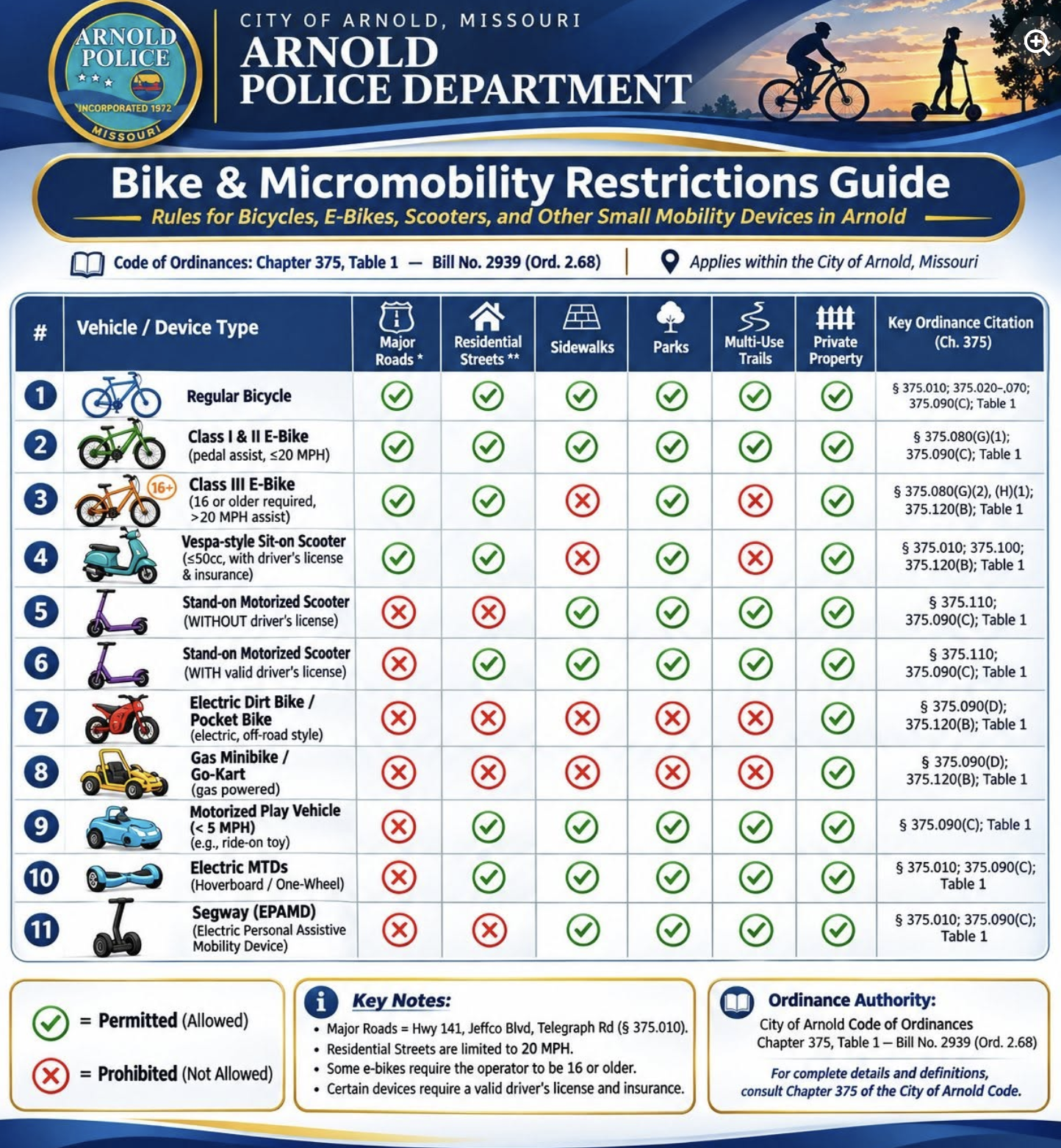
The illustrated guide provides a side-by-side comparison of 11 categories of bicycles and motorized devices, including traditional bicycles, electric bicycles, scooters, electric dirt bikes, gas-powered minibikes, hoverboards and Segways.
Among the distinctions outlined in the guide, stand-on motorized scooters operated without a driver's license are prohibited from public roads but may be used on sidewalks, parks and multi-use trails. Operators with a valid driver's license may also use these scooters on residential streets, subject to the ordinance.
Electric dirt bikes, pocket bikes, gas-powered minibikes and go-karts are prohibited from public roads, sidewalks, parks and multi-use trails but may be operated on private property, subject to applicable requirements.
The department's guide also distinguishes between major roads, including Highway 141, Jeffco Boulevard and Telegraph Road, and residential streets with speed limits of 20 mph or less.
The city encourages residents and parents to familiarize themselves with the restrictions, particularly before purchasing or allowing children to operate electric bicycles and scooters.
Graphic courtesy of the City of Arnold Police Department. The department released its Bike & Micromobility Restrictions Guide to clarify the requirements established under Chapter 375 of the Arnold Code of Ordinances.
Other Council Business
The November 5 meeting also included amendments to the city's commercial parking regulations, reducing the parking requirement for retail uses from 4.5 to four spaces per 1,000 square feet of floor area. The changes also corrected a discrepancy in the definition of a standard parking space, which remains 10 feet by 19 feet.
The council also considered agreements related to county road funding, recreation center software and a law enforcement partnership.
During public comments, a representative of The Salvation Army Jefferson County Service Center encouraged participation in the organization's Christmas bell-ringing and Angel Tree programs.
Stephen Spurgeon, a representative of the Hemmwood subdivision, raised concerns about unfinished neighborhood infrastructure and the potential costs facing homeowners if outstanding development obligations are not resolved.
City officials indicated that further discussions would be arranged concerning those subdivision issues.
Decisions at City Hall Affect Your Neighborhood
From new housing developments to the rules governing our streets and sidewalks, local government decisions impact everyday life in Jefferson County.
The Jefferson Review keeps you informed with independent local reporting on the votes, discussions, and decisions shaping our communities.
Stay informed. Stay connected. Subscribe free today.
Jefferson County news delivered to your inbox every Thursday and Sunday.