

Amato Says Arnold TDD Audit Should Lead to Clearer State Law, Stronger Local Safeguards
State Rep. Phil Amato, a Republican from Arnold who represents Missouri’s 113th House District, says the findings from the recent state audit involving Arnold’s Transportation Development District should not be the end of the conversation.
Instead, Amato said he hopes the audit becomes the starting point for clearer state law, stronger local safeguards, and a better understanding of what cities can and cannot do when public money, development districts, and closed-door legal discussions overlap.
Amato, a former Arnold city councilman and longtime city resident, said he and Rep. David Casteel both contacted the Missouri State Auditor’s Office after residents raised concerns about the TDD and the proposed road project that had drawn public attention.
Amato said he has spent time reading through the audit report carefully, making notes and separating two different categories of concern. In his view, some findings may involve clear legal questions, while others may point to areas where the law allows something that still makes citizens uncomfortable.
That distinction, he said, matters as lawmakers consider whether changes are needed in Missouri’s TDD statutes.
Amato said his goal is to meet with the auditor’s office, along with Casteel, to better understand which parts of the report raised legal concerns and which parts exposed gray areas in state law.
One area Amato specifically wants clarified is whether TDD board members should be completely separate from city officials. The audit raised concerns about overlapping roles between city government and the TDD, and Amato said that may be one of the clearest places for lawmakers to consider new safeguards.
He also said future legislation could address whether a TDD should have an attorney fully separate from the city attorney, creating what he called a “firewall” between the two entities.
That question ties into a local issue already moving forward in Arnold, where the new city council has pursued a request for qualifications for legal representation. Amato said he views the city’s decision to seek new legal guidance as a meaningful step toward addressing some of the concerns raised in the audit.
Amato said legal advice is not just a formality for elected officials. It can determine whether those officials remain protected if their decisions are challenged in court.
But Amato said that protection can become complicated if elected officials ignore legal advice.
That is one reason, he said, city officials often rely heavily on attorneys, particularly in complicated matters involving development, closed sessions, land acquisition, and litigation strategy.
Amato also addressed one of the more publicly misunderstood parts of local government: closed-door meetings.
Under Missouri’s Sunshine Law, public bodies are allowed to meet in closed session for specific reasons, including personnel matters, real estate transactions, and legal advice. Amato said those exceptions exist for practical reasons.
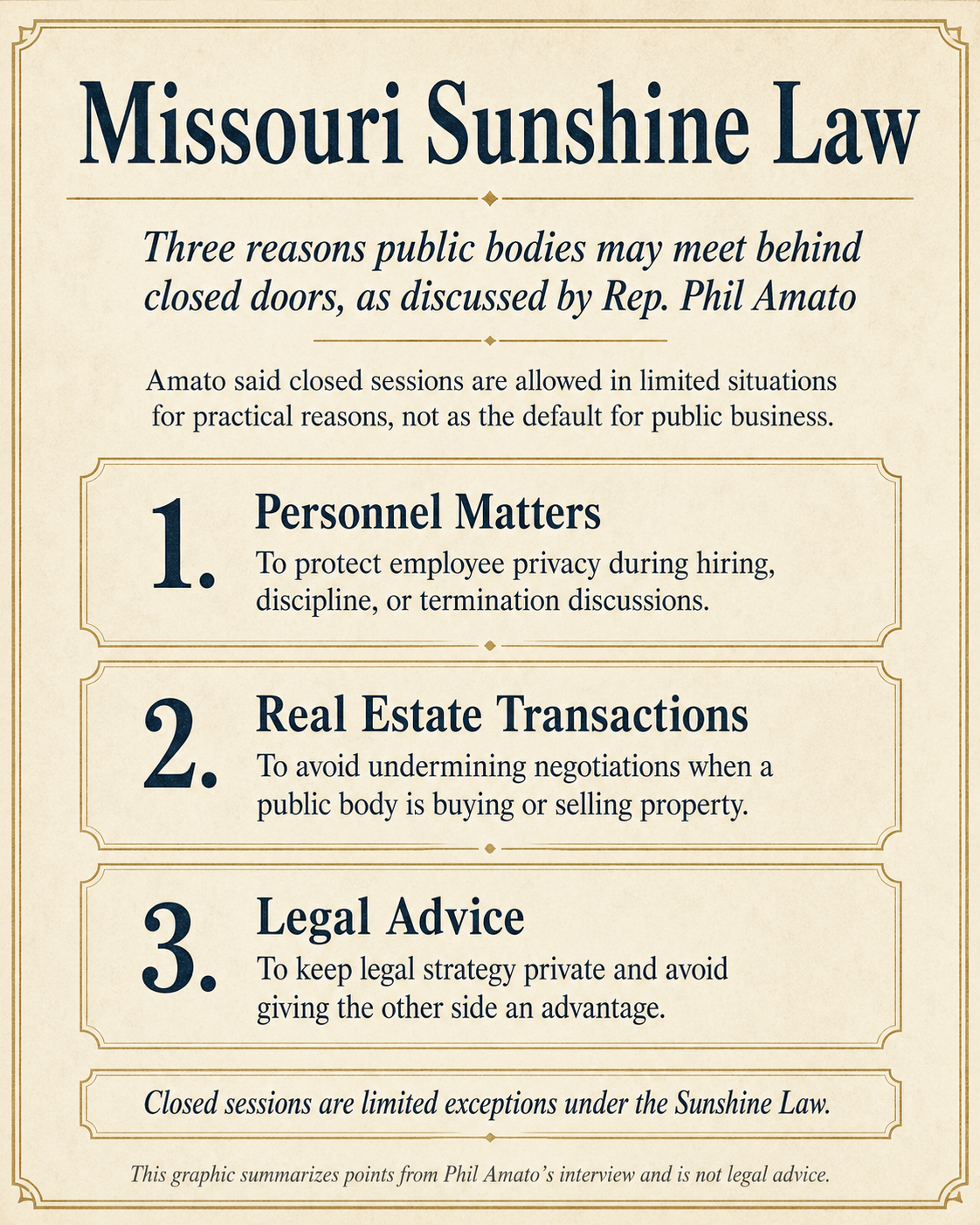
He added that real estate discussions may need to be private so government entities do not weaken their own negotiating position. The same is true, he said, for legal matters.
At the same time, Amato said he understood why residents were uneasy when closed-door meetings became part of the discussion surrounding the audit. He said those concerns are exactly why clearer rules and stronger separation between entities could help restore confidence.
For Amato, the audit should not simply become a political argument over the past. He said it should be used to identify what was illegal, what was unclear, and what needs to be changed so future communities are not left with the same unanswered questions.
He also said Arnold’s next chapter will require more than legislation. It will require public officials to communicate clearly, residents to stay engaged, and both sides to recognize that rebuilding trust takes time.
One of Amato’s suggestions was to bring more residents directly into the process, particularly those with professional backgrounds in development, finance, engineering, accounting, or public administration. He said Arnold likely has citizens with the experience needed to help guide complicated issues like the TDD, but many may never step forward unless they are asked.
Amato said one way to move forward would be to invite citizens to submit resumes for possible service on boards connected to the TDD, while also creating clearer separation between city government and the district itself. That could include separate legal counsel, clearer board membership, and stronger safeguards against perceived conflicts of interest.
For elected officials, Amato’s advice was to rely on sound legal guidance, avoid unnecessary conflicts, and make decisions in a way residents can understand. For citizens, his message was to stay involved, ask questions, and look for constructive ways to serve rather than allowing frustration over the audit to become permanent division.
In Amato’s view, Arnold’s response to the audit will matter as much as the findings themselves. If the city uses the moment to clarify the law, improve oversight, and invite more citizen involvement, he said the controversy could become a turning point rather than just another political fight.
The Jefferson Review brings local government, community stories, business features, events, and hometown news straight to your inbox twice a week.
If you care about what is happening in Jefferson County, make sure you are part of the conversation.