


$1.6 Million in Arnold Tax Revenue Under Legal Review by New Lawyer
What began as a discussion about updating the rules governing Arnold's Tourism Commission has opened the door to a much larger question: For years, where has the city's tourism tax money been going, and has it been handled in accordance with Missouri law?
During the Arnold City Council's November 12 work session, council members were scheduled to review proposed revisions to the city's Tourism Commission ordinance. The changes included new financial controls, revised membership requirements, and the possible elimination of a $20,000 annual funding limit for individual recipients.
But as the council discussed how tourism organizations should document their expenses, Councilman Brad Cary raised questions about the city's own use of tourism revenue, including money identified in city budgets as a pass-through to Tax Increment Financing, or TIF.
The discussion came just seven months after Missouri State Auditor Scott Fitzpatrick issued a sharply critical audit of Arnold's financial practices, and only months after Cary was removed from a budget meeting during which tourism funding was among the subjects under consideration.
Now, City Attorney Mark Bishop is reviewing the tourism-to-TIF arrangement, while the council has postponed further discussion of the Tourism Commission ordinance until a future work session.
The developments raise a significant question: If organizations receiving tourism money must prove exactly how every dollar is spent, what documentation has the city maintained for its own use of those same funds?
A Councilman Previously Removed From Budget Discussions Raises New Questions
For Councilman Brad Cary, the November discussion marked a significant change from his experience during the city's summer budget process.
On August 24, Mayor Bill Moritz removed Councilman Cary from council chambers during a special City Council budget work session.
The decision prevented Cary from participating in the broader budget discussion, including matters unrelated to the identified conflict.
The exclusion became the subject of a public dispute, and the City Council subsequently voted to censure the mayor.
Cary also faced restrictions on discussing tourism-related budget matters as the city worked toward adopting its fiscal year 2027 budget.
Those restrictions took on new significance during the November work session, when Cary was able to participate in questions about the Tourism Fund and its relationship to the city's redevelopment financing.
The issue centered on a recurring line in Arnold's budgets labeled "PASS THRU TIF SALES TAX."
The amount in question was described during the work session as approximately $173,000 in tourism money being directed toward TIF obligations rather than tourism events.
City Administrator Anthony Traxler confirmed that the matter was receiving legal attention per a previous conversation with Cary, stating:
"That's what the city attorney, Bishop, is looking into right now."
The answer did not establish that the payments were illegal. But it confirmed that the legal basis for a longstanding financial arrangement was under examination at City Hall.
It also raised a broader concern: Why has an arrangement involving tourism revenue continued for years without its legal justification being clearly explained to the public?
A State Audit Had Already Raised Questions About Arnold's Financial Oversight
The new questions come against the backdrop of a state audit released in April of 2026.
State Auditor Scott Fitzpatrick's investigation examined Arnold's relationship with two Transportation Development Districts and found serious deficiencies in financial oversight, transparency, and compliance with state law.
The audit assigned the city and its TDDs a rating of "poor," the lowest rating issued by the State Auditor's Office.
Among its findings, auditors concluded that the city had used TDD revenue to support broader redevelopment goals, maintained inadequate oversight of district activities, and failed to meet certain financial reporting requirements.
Fitzpatrick warned that residents needed to closely examine how city officials were administering these public funds.
In his official statement accompanying the audit, he urged Arnold residents to consider what the findings revealed about their government and its responsibility to taxpayers.
The recommendation addresses a fundamental principle of public financial oversight: restricted revenue should remain identifiable and traceable to the purposes for which it is authorized.
The Arnold mayor disputed the auditor's conclusions and maintained that its financial reporting was sufficient.
Tourism Commissioners Say They Asked for Guardrails for Years
While questions about city finances were coming to the surface, members of Arnold's Tourism Commission were describing a separate, longstanding struggle to obtain clear financial guidance.
During the commission's October meeting, former City Attorney Bob Sweeney addressed concerns about the administration of tourism tax revenue.
Sweeney acknowledged that commissioners had been operating without adequate formal guidance, training, or procedures for verifying how funding recipients spent public money.
But commissioners insisted those concerns were not new.
Former Commissioner Ken "Wally" Lionberger told those attending:
"We've been raising that flag for a long time."
He also said:
"We have requested training and guidance."
Former Commission President Drew Sofia explained that commissioners had repeatedly asked former city administration officials to establish safeguards, including collecting receipts from organizations receiving funding.
The commissioners' concerns went beyond whether individual events deserved financial assistance. They wanted a process that could demonstrate that tax dollars were being used for legally permitted purposes.
The distinction is important. Commissioners were not necessarily accusing grant recipients of misconduct. They were asking for the city to provide them with the records and procedures needed to demonstrate proper spending.
Those requests now stand in contrast to the questions surrounding how the city itself has accounted for tourism revenue.
What Is TIF, and Why Is Tourism Money Going There?
Tax Increment Financing, commonly called TIF, is a redevelopment financing mechanism authorized by Missouri law.
When a qualifying redevelopment project is established, certain increases in tax revenue generated within the redevelopment area may be directed toward approved project costs or debt obligations.
The purpose is to help finance improvements associated with redevelopment, such as infrastructure, site preparation, and other eligible project expenses.
It is important to note that TIF revenue and tourism-tax revenue are not automatically interchangeable.
Arnold's 5% hotel-motel tourism tax was approved by voters on April 8, 2003.
The tax was presented as a means of stimulating tourism and the local economy.
Missouri law places specific restrictions on how that money may be used.
Section 67.1364 of the Revised Statutes of Missouri states:
"The revenue received from the tax shall be deposited in a special fund and used solely to promote tourism."
The same law assigns responsibility for administering those funds to the Tourism Commission for distribution.
That means tourism revenue is not ordinary unrestricted city income.
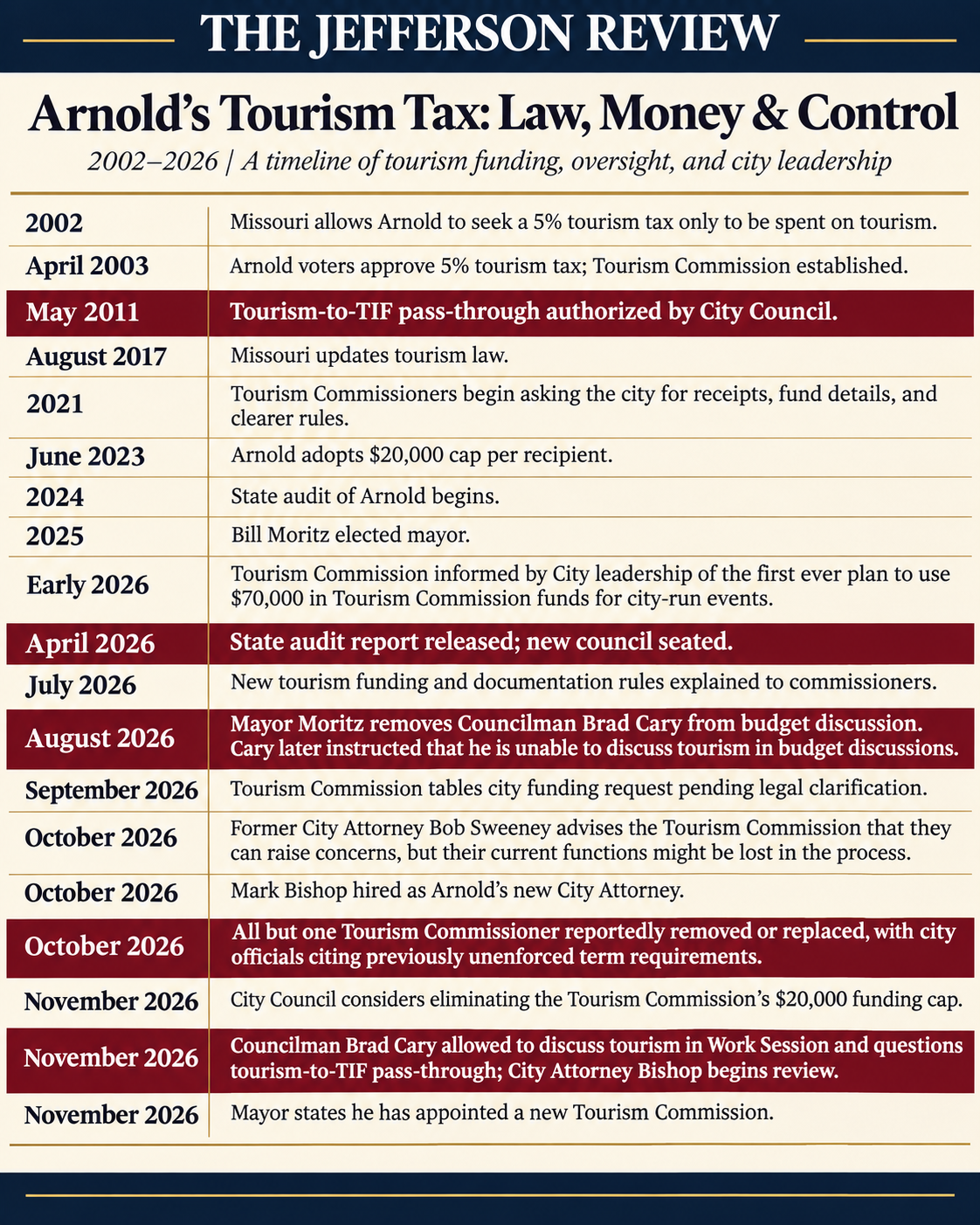
Years of Tourism Revenue Directed Toward TIF
The tourism-to-TIF pass-through is not a newly created budget item.
City financial records show that the arrangement dates back to at least 2011, when Arnold's budget identified tourism-related revenue being directed toward TIF financing.
Over time, the amounts became a recurring part of the city's financial planning.
Our review of Arnold's historical financial reports identified approximately $1.6 million in tourism-related revenue recorded for Crossroads TIF Subarea 1 between fiscal years 2015 and 2024.
That ten-year figure does not represent the entire history of the arrangement. Earlier and more recent years must also be accounted for to establish the full amount.
The city's more recent budgets continued identifying substantial tourism-to-TIF allocations.
Mayor Moritz Disputes the Auditor's Conclusions
Mayor Bill Moritz has consistently challenged the state's characterization of Arnold's financial practices.
Following the April audit, Moritz spoke with The Jefferson Review and defended the city's handling of its redevelopment districts.
"I think the city acted appropriately," Moritz said.
The city subsequently published a detailed response disputing several of the State Auditor's findings.
City officials maintain that they acted within the law and have challenged the auditor's interpretation of the financial arrangements.
Fitzpatrick's office, however, stood by its findings.
In public remarks, the auditor described the use of district revenue as a "sort of slush fund" supporting the city's larger redevelopment objectives.
This broader warning about public accountability should not be taken lightly.
Fitzpatrick, a Republican who won reelection as Missouri State Auditor on November 3, has repeatedly emphasized the importance of ensuring that governments use restricted revenues for their intended purposes.
The disagreement between the city and the auditor remains unresolved in their public statements. But the city's own Tourism Commission is now facing questions about financial oversight similar in principle to concerns raised in the audit.
New Rules for Tourism Applicants, but Questions About City Spending Remain
During the November 12 work session, City Attorney Mark Bishop and City Administrator Anthony Traxler outlined proposed changes to the Tourism Commission ordinance intended to clarify its operations and establish stronger financial controls.
The discussion also included a proposal to remove the existing $20,000 annual cap on funding to an individual applicant.
Some council members expressed concern that eliminating the limit could allow a small number of applicants, including the city itself, to receive a substantially larger share of available tourism funding.
That concern was particularly relevant because city leadership had already discussed directing approximately $70,000 in tourism revenue toward city-operated events.
Former Tourism Commission President Drew Sofia previously told commissioners that Mayor Moritz and City Administrator Anthony Traxler had discussed the city's intention to use the anticipated additional revenue for municipal events.
Sofia worried that the change could reduce the funding available for other organizations trying to establish or expand events in Arnold.
Hundreds of Thousands More Than the Annual Tourism Budget?
During the November work session, City Administrator Anthony Traxler revealed that the money budgeted for tourism expenditures was not the same as the total amount accumulated in the Tourism Fund.
"You know we've got a large fund balance in this account," Traxler said. "This account it should be this money should be spent down for tourism events."
He explained that city officials intended to address the accumulated balance through a midyear budget adjustment, making additional money available for city use on tourism-related expenditures.
When councilmen questioned that amount in comparison to the approximately $180,800 budgeted for tourism expenditures during the previous fiscal year, Traxler clarified that he was referring to the fund's accumulated balance, not its annual spending allocation.
Arnold's FY2024 audited financial report shows the Tourism Fund ended that fiscal year with a balance of $697,362.
While that figure does not establish the fund's current balance, it illustrates the substantial difference between money appropriated for tourism activities in a single year and restricted tourism revenue accumulated over time.
The revelation raises additional questions about how much money the Tourism Commission had available, whether commissioners and council members received regular reports showing the accumulated balance, and why the city had not previously established a clear process for putting those funds toward tourism-related activities already.
The City Attorney Is Now Reviewing the Documents
For now, Arnold's tourism-to-TIF pass-through remains under review.
During the November work session, City Administrator Anthony Traxler confirmed that City Attorney Mark Bishop was examining the matter.
The outcome could clarify whether the city's longstanding arrangement is supported by the applicable ordinances, redevelopment agreements, and state statutes.
It could also provide an opportunity for officials to explain exactly how much tourism revenue has been directed toward TIF obligations and which documents authorize those payments.
The Jefferson Review has been seeking documentation related to these financial arrangements for months.
Those requests have not yet produced the complete records needed to reconcile the historical transactions and explain the legal foundation for the pass-through.
Perhaps the city's new attorney will have better success obtaining and examining the documents than the public has had in requesting them.
The council ultimately tabled the proposed Tourism Commission ordinance changes and plans to revisit the matter at a future work session.
That leaves the city with several unresolved questions: how tourism revenue has been handled, whether the historical TIF payments comply with the law, how the Tourism Commission will operate going forward, and what safeguards will apply to the city's own spending.
The city is now asking tourism organizations to account for their spending with greater precision. It is reasonable for Arnold taxpayers to ask their city government to do the same.
The documents, accounting records, and legal explanations necessary to answer those questions should not be difficult for the public to obtain.
After all, these are public funds, collected under public law, and spent in the public's name.
The Jefferson Review will continue following the City Attorney's review, the council's proposed tourism ordinance changes, and the records supporting Arnold's tourism-to-TIF payments.